
E-E-A-T in Practice: Building Genuine
Authority Content That Ranks
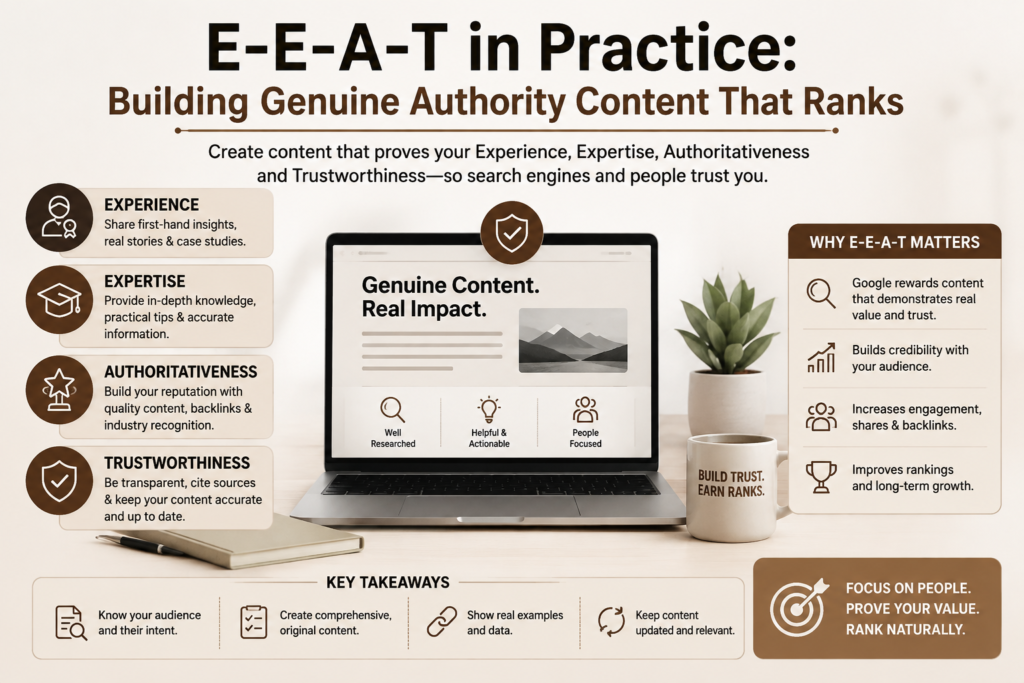
If you’ve spent any time in SEO circles over the past couple of years, you’ve heard the acronym thrown around like gospel: E-E-A-T — Experience, Expertise, Authoritativeness, and Trustworthiness. Google introduced it as part of its Search Quality Rater Guidelines, and it has since become one of the most misunderstood concepts in content marketing.
Here’s the problem: most brands treat E-E-A-T as a checklist. Add an author bio. Get a few backlinks. Slap on a “medically reviewed by” badge. Done.
But E-E-A-T was never meant to be a checklist — it’s a signal of genuine quality that Google’s algorithms try to approximate. In a world flooded with AI-generated content, the brands that actually build real experience, expertise, authority, and trust into their content are the ones that will keep ranking — and the ones that get cited by AI search tools like ChatGPT, Perplexity, and Google’s AI Overviews.
This post breaks down what E-E-A-T actually looks like in practice, not in theory.
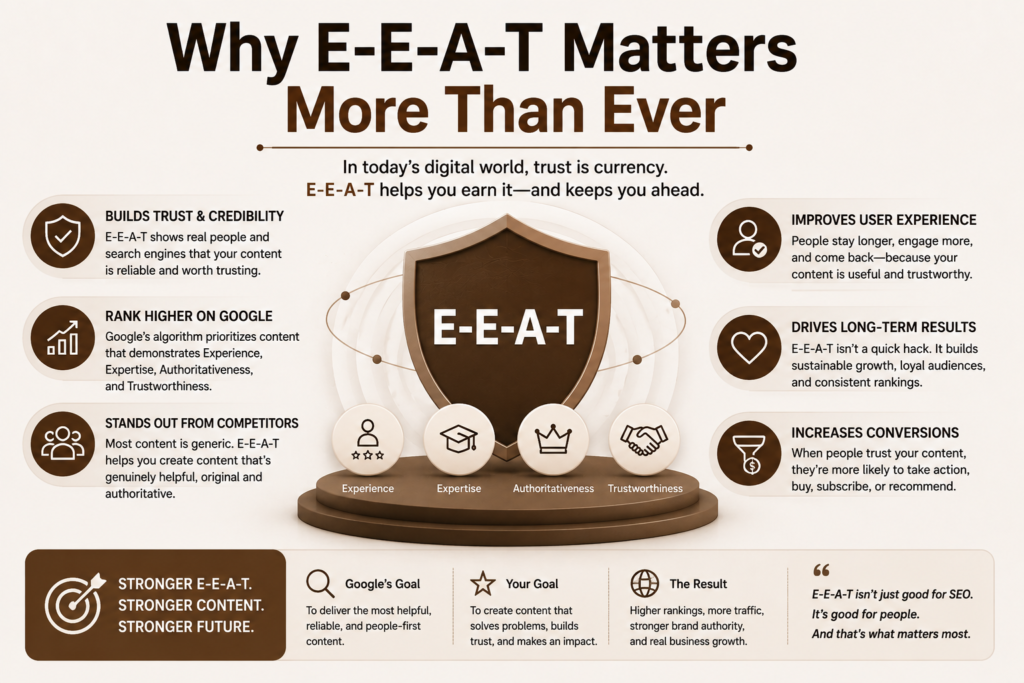
Why E-E-A-T Matters More Than Ever
Search has changed. It’s no longer just about ranking on a results page — it’s about being the source an AI model trusts enough to cite or summarize. Both classic SEO and this newer “answer engine” visibility reward the same underlying thing: content that demonstrates real, verifiable authority.
Generic, keyword-stuffed, AI-spun content is easier to produce than ever — which means it’s also easier to spot and demote. Search engines are actively working to surface content written by real people with real experience, because that’s what users (and now, AI systems summarizing the web) actually want.
Breaking Down the Four Pillars
1. Experience — "Have you actually done this?"
This is the newest addition to the framework, and it’s the one most brands skip entirely.Experience means first-hand, lived knowledge of a topic — not just researched knowledge. A blog post about hiking boots written by someone who has hiked 500 miles in them reads differently than one assembled from ten other articles.
In practice:
- Include original photos, screenshots, or data from your own use of a product or process
- Write from a first-person perspective when relevant (“When we tested this…”)
- Share specific, granular details that only come from doing the thing (exact numbers, unexpected outcomes, mistakes made)
- Feature case studies or customer stories with real names, real results, and real context
2. Expertise — "Do you actually know this?"
Expertise is about depth of knowledge in the subject matter, and it doesn’t always require a formal credential — but it does require demonstrated competence.
In practice:
- Have subject-matter experts write or review content, not just generalist copywriters
- Go beyond surface-level advice; answer the follow-up questions a true expert would anticipate
- Use precise, correct terminology instead of vague marketing language
- Update content when the underlying facts change (an “expert” who never updates outdated info isn’t much of an expert)
3. Authoritativeness — "Are you recognized as a go-to source?"
Authority is reputation — what other credible sources, sites, and people say about you, not just what you say about yourself.
In practice:
- Earn backlinks and mentions from respected, relevant sites in your industry
- Get quoted in journalism, podcasts, or industry reports
- Build a consistent, recognizable brand presence across platforms
- Encourage genuine user-generated content, reviews, and discussion around your brand
4. Trustworthiness — "Can readers rely on this?"
Trust is the umbrella pillar — Google has said it’s the most important of the four, because even highly experienced, expert, authoritative content is worthless if it isn’t accurate or honest.
In practice:
- Cite sources and link to primary data wherever possible
- Be transparent about affiliate relationships, sponsorships, or conflicts of interest
- Keep a visible, accurate author bio with real credentials
- Maintain accurate contact information, business details, and a genuine privacy policy
- Fix errors publicly and promptly rather than quietly editing them away
How to Build E-E-A-T Into Your Content
Process (Not Bolt It On After)
- Assign real people to real topics. Match writers to subjects they genuinely understand or have access to — don’t ask a generalist to fake expertise in a specialized field.
- Build an expert review layer. Before publishing, have a qualified person fact-check and sign off on technical or high-stakes content.
- Document original data and experience. Run your own surveys, tests, or product trials. Original data is one of the strongest authority signals because it can’t be copied.
- Make authorship visible and verifiable. Full name, credentials, a linked bio page, and — ideally — a presence elsewhere online (LinkedIn, published work, speaking engagements).
- Audit and refresh regularly. Set a cadence (quarterly or biannually) to review older content for accuracy, outdated claims, and broken sources.
- Earn authority instead of manufacturing it. Skip link schemes. Invest in PR, partnerships, original research, and genuinely useful content that people want to reference.
A Quick Self-Audit
Before you publish your next piece, ask:
- Could this have been written by someone who has never actually done this? If yes, it needs more first-hand detail.
- Would an actual expert in this field nod along, or wince?
- If a stranger fact-checked every claim, would it hold up?
- Is it obvious who wrote this, and why they’re qualified to?
If any answer gives you pause, that’s your revision list.
The Bottom Line
E-E-A-T isn’t a ranking factor you can hack — it’s a description of what genuinely good, trustworthy content looks like. The brands treating it as a real content philosophy, rather than a compliance checklist, are the ones building the kind of durable authority that holds up whether a human is reading it on page one of Google or an AI is summarizing it as the “best answer” to a query.
In a content landscape increasingly crowded with AI-generated noise, real experience and real expertise aren’t just SEO tactics anymore — they’re the differentiator.