
The Rise of "Dark Social": Tracking
Marketing Impact Outside Public Feeds
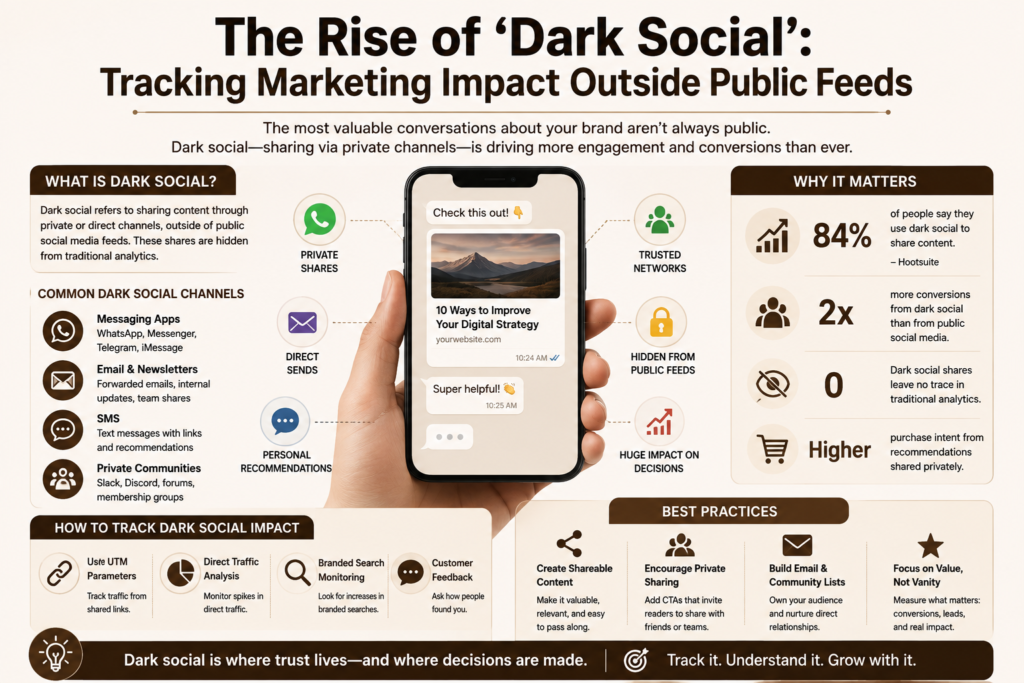
Open your analytics dashboard right now and look at your traffic sources. Chances are you’ll see a chunk of visits labeled “direct” that makes no logical sense — people who supposedly typed your exact URL from memory, again and again, with no referral source attached.
They didn’t type it from memory. They clicked a link someone sent them in a DM, a WhatsApp group, a Slack channel, or a text message. That traffic is real, it’s often some of your most engaged and highest-converting traffic — and your analytics tools have almost no idea where it came from.
This is dark social, and it’s quietly become one of the biggest blind spots in digital marketing.
What Is Dark Social, Actually?
The term was coined back in 2012 by Alexis Madrigal at The Atlantic, describing the vast amount of content sharing that happens through channels analytics tools can’t track — private messages, email, texting apps — as opposed to the public shares on platforms like Facebook or X that show up neatly in a dashboard.
More than a decade later, the problem hasn’t gone away. It’s exploded, because the way people share content has fundamentally shifted:
- Private messaging apps (WhatsApp, iMessage, Telegram, Signal) now carry more link sharing than public social feeds in many markets
- Group chats and Discord/Slack communities have become primary discovery channels, especially among younger audiences
- Stories and ephemeral content (Instagram/Snapchat Stories) often aren’t crawlable or trackable the way feed posts are
- Screenshotting instead of sharing links means content spreads without a single trackable click
When someone screenshots your Instagram post and sends it to five friends on WhatsApp, that’s marketing impact your dashboard will never show you.
Why This Matters for Marketers
- You’re underinvesting in what actually drives conversions. If your best customers are arriving via dark social but your attribution model credits “direct,” you might be starving the very channels and content types generating that word-of-mouth.
- Your ROI reporting is skewed. Campaigns that spark private sharing (which is often the most trusted form of recommendation) look like they’re underperforming compared to campaigns optimized for public, trackable clicks.
- Trust is shifting private. People increasingly share and discuss brands in smaller, closed spaces rather than public feeds — partly due to privacy fatigue, partly because recommendations from a friend in a DM carry more weight than a public post.
- AI chat tools are compounding the problem. Conversations happening inside ChatGPT, Perplexity, or other AI assistants about your brand are another layer of dark, unattributable influence.
Ignoring dark social doesn’t mean it isn’t happening — it means you’re flying blind on a growing share of your actual impact.
How to Start Tracking (and Optimizing For)
Dark Social
You’ll never fully “solve” dark social attribution — that’s inherent to its nature — but you can get meaningfully closer.
1. Use UTM parameters relentlessly, even for organic content
Add UTM tags to every link you publish, including social bios, email signatures, and QR codes. When someone copies and shares a link with a UTM tag intact, you at least recover some visibility.
2. Build shareable, "forwardable" assets on purpose
Design content with private sharing in mind: quotable graphics, short clips, screenshot-friendly stat callouts, and swipeable carousels people actually want to send to a friend. Include a subtle branded watermark or short URL so screenshots still carry attribution.
3. Audit your "direct traffic" spikes
Look for direct traffic spikes that correlate with specific campaigns, PR mentions, or content pushes. A spike in direct traffic right after a piece goes semi-viral is a strong dark social signal, even without perfect attribution.
4. Add easy native share buttons for private channels
Make it frictionless to share via WhatsApp, SMS, and email — not just X and Facebook. Native share sheets that include these options increase both sharing volume and the odds a UTM-tagged link survives the journey.
5. Run surveys and post-purchase attribution
Ask directly: “How did you hear about us?” with an option like “a friend sent me a link” or “someone shared it with me.” This qualitative layer catches what pixels can’t.
6. Track branded search and referral clusters
If dark social sharing is working, you should see a rise in branded search queries and direct visits to specific landing pages — even without a clean referral trail. Treat these as proxy metrics.
7. Invest in community and advocacy programs
Since dark social is fundamentally about trusted, personal recommendation, lean into what fuels it: referral programs, ambassador communities, and genuinely shareworthy customer experiences.
Reframing Success Metrics
If your team only rewards content for its trackable public engagement, you’ll unconsciously optimize away from the very content most likely to spread privately — the stuff people actually want to send to one person, not broadcast to everyone.
Consider adding softer, directional KPIs alongside your hard attribution numbers:
- Direct traffic trends over time, segmented by campaign windows
- Branded search volume as a proxy for word-of-mouth reach
- Share-button usage on private channels (even without full attribution)
- Post-purchase survey responses citing personal referral
None of these are perfect. Together, they paint a much more honest picture than “direct / (none)” ever will.
The Bottom Line
Dark social isn’t a tracking bug to be fixed — it’s a permanent, growing feature of how people actually discover and discuss brands today. The marketers who win aren’t the ones who find a perfect attribution model; they’re the ones who accept the blind spot, build content genuinely worth sharing in private, and use proxy signals to invest smartly in what’s actually working — even when the dashboard can’t prove it directly.