
Local SEO for 2026: What's Changed with
Google's Latest Algorithm Updates
If your local rankings for Local SEO for 2026 have felt shakier than usual this year, you’re not imagining it. Google rolled out several confirmed core updates between February and June 2026, alongside a steady stream of Google Business Profile (GBP) changes, Discover refinements, and continued AI integration into local search results. The businesses holding steady through all of it aren’t the ones chasing every algorithm headline — they’re the ones with fundamentals so strong that volatility barely touches them.
Here’s what’s actually changed in Local SEO for 2026, and what to do about it.
The Big Shift: AI Is Now Part of the Local Pack
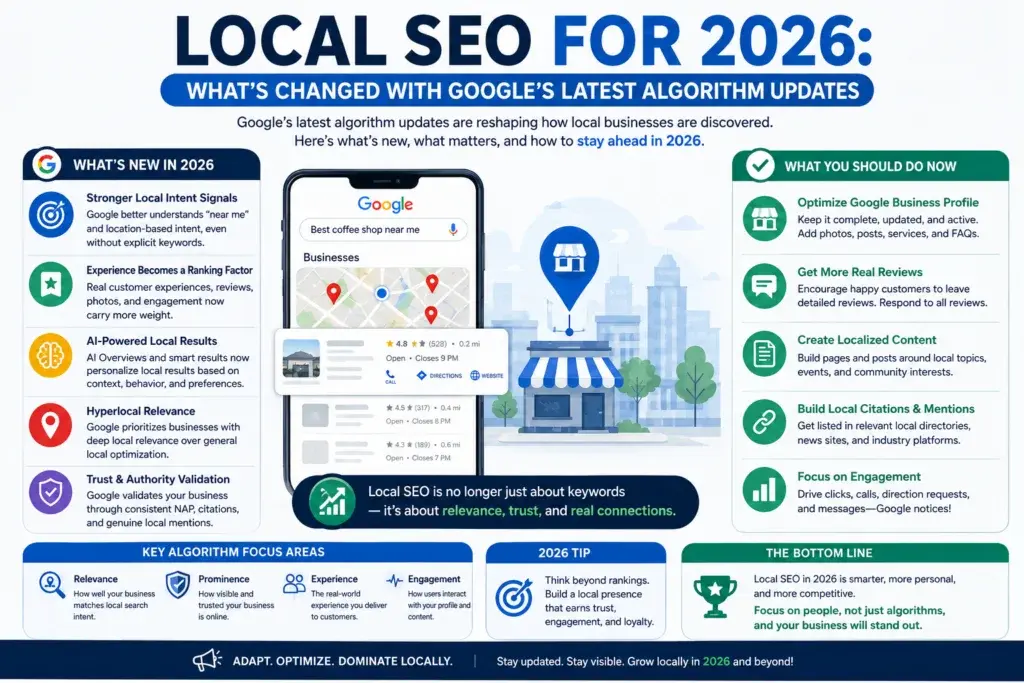
The most significant change in Local SEO for 2026 isn’t a single update — it’s the deepening integration of AI directly into local search. AI-powered local packs and AI Q&A features are increasingly replacing traditional list-style results, often favoring businesses that are active and responsive rather than simply well-established. Nearly half of all Google searches now carry some form of local intent, and AI Overviews are showing up inside those results more than ever before.
This matters for Local SEO for 2026 because visibility isn’t just about ranking #1 in a blue-link list anymore — it’s about being the business an AI system chooses to surface, describe, or recommend when someone asks a local question.
What this means for you
- Being “technically ranked” isn’t enough if AI systems aren’t citing or describing your business accurately
- Consistency of your business information across the web now feeds AI training and retrieval, not just traditional indexing
- Entity recognition — Google clearly understanding what your business is and who it serves — has become a ranking factor in its own right
Reviews Carry More Weight Than Ever —
But It's About Velocity, Not Just Volume
Review signals now account for a substantial share of local ranking weight, and the data is clear on one point: a business earning a steady trickle of new reviews consistently outranks a competitor sitting on a larger pile of stale ones. Recency and responsiveness matter as much as star rating.
There’s also a new threshold worth knowing: businesses need meaningfully more reviews per location before AI Overviews and LLM-based platforms like ChatGPT and Perplexity treat them as citation-worthy sources.
What this means for you
- Build an ongoing review generation process — not a one-time push
- Respond to reviews (especially recent ones) consistently; response rate is itself a signal
- Don’t rest on a strong historical review count if new reviews have slowed to a trickle
- Treat review volume as a stepping stone toward AI visibility, not just star-rating optics
Google Business Profile Activity Is a
Ranking Lever, Not Just a Listing
One of the clearer, more actionable findings from 2026 tracking: businesses that increased their GBP posting frequency and added fresh, service-specific photos saw measurable ranking improvements — in some cases moving up several positions in a couple of months with no other changes made.
GBP is no longer a “set it up once” asset. It behaves more like a lightweight content channel Google actively rewards for freshness.
What this means for you
- Post to GBP on a regular cadence (weekly, at minimum) with real updates — offers, projects, service highlights
- Add new, genuine photos regularly, not stock imagery
- Keep hours, services, and categories meticulously accurate and updated
- Use GBP’s Q&A and messaging features actively; responsiveness is being read as an engagement signal
Google Keeps Cracking Down on "Parasite
SEO" and Spam at the Local Level
Google has been publicly and aggressively enforcing against “parasite SEO” — content or ads placed on trusted third-party sites purely to borrow their authority — and continued to tighten that enforcement through 2026’s spam updates. Similar crackdowns are extending to local search, targeting manipulative citation practices and fake or incentivized reviews.
What this means for you
- Don’t rely on shortcuts like paid guest posts on unrelated high-authority sites for local rankings
- Keep citation building genuine and consistent — inconsistent NAP (name, address, phone) data across directories is increasingly penalized, not just ignored
- Avoid review-gating or incentivizing reviews in ways that violate platform policy; enforcement has gotten sharper
Content Quality Standards Have
Tightened Again
Google’s Helpful Content system has moved toward deeper AI-driven evaluation — assessing not just keyword relevance but tone, depth, and genuine user satisfaction. For local businesses, that means location pages and service pages need to read as genuinely useful to a real customer, not as thin, templated pages built purely to target city-name keywords.
Content that performs well in Local SEO for 2026 tends to share a few traits: a direct answer up front, clean structure, factual accuracy, real context specific to the business or area, and a clear point of view grounded in actual expertise — the same E-E-A-T principles reshaping SEO more broadly.
What this means for you
- Retire or substantially rewrite thin “[Service] in [City]” pages that don’t offer unique value
- Include specifics only a real local business would know — neighborhood names, local landmarks, genuinely local case studies
- Structure pages for direct, scannable answers, since AI systems tend to pull from clearly structured content
A Practical 2026 Local SEO Checklist
- combinations
- Monitor Discover performance separately from classic search traffic — they’re increasingly driven by different signals
- Track how AI tools describe your business by testing queries in ChatGPT, Perplexity, and Google’s AI Overviews directly
- Respond to every rAudit GBP activity — are you posting and adding photos at least weekly?
- Check review velocity, not just review count — are new reviews coming in consistently?
- Verify NAP consistency across all directories and citation sources
- Review your local landing pages for thin or duplicated content across city/service eview and GBP message within a reasonable window
The Bottom Line
Succeeding in Local SEO for 2026 isn’t really about chasing a specific algorithm tweak — they’re about Google (and now AI search platforms alongside it) getting better at identifying which local businesses are genuinely active, genuinely trusted, and genuinely useful to the people searching for them. Consistent GBP activity, real review velocity, clean citation data, and content built for actual customers rather than search engines will outperform any shortcut, and increasingly, they’re the only path to being visible in AI-driven local results at all.